Product design
02 Lumesphere
Role Research, Ideation, User study, Outer layer
of experience prototypes
Lumesphere is an interactive household object that explores how intelligent products can foster meaningful social interaction. Through shape, colour and warmth, private interactions become subtle signals within the home, encouraging curiosity and conversation while preserving personal privacy.
Process
This project explored how Internet of Things technologies could strengthen social collaboration and interaction within a speculative household in 2037. Designing for a family of six, including an injured aunt and a service dog, provided a complex social context in which intelligent objects became active participants in everyday life.

.png)
Early research, benchmarking and roleplay exercises revealed how quickly small interruptions accumulate into feelings of distraction and disconnection. Rather than improving efficiency, the design opportunity became protecting meaningful social interaction by increasing awareness of the presence and actions of other intelligent entities within the home.

Iterative prototyping explored how form, materiality and interaction influenced emotional interpretation. User studies demonstrated that warmer materials, increased weight and soft textures encouraged more intimate interactions, while additional research into colour perception informed the emotional behaviour of the object.

The final concept evolved into an autonomous interactive light companion that subtly communicates emotional presence through changing shape, colour and movement. Rather than explicitly conveying emotions, it encourages conversation by leaving room for interpretation.


%20(1).jpg)

Design opportunity
Interaction and material exploration
Final concept definition
%20(1).jpg)
.jpg)
.png)
.png)
_edited.png)
.png)

.jpg)
.png)
.jpg)


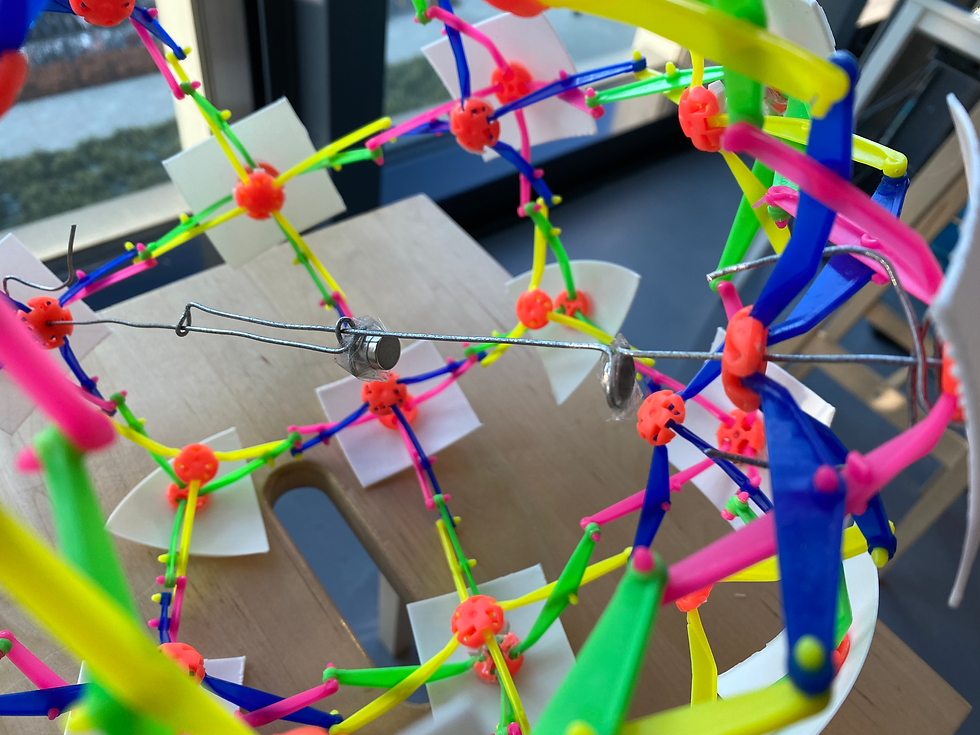

The project concluded with three experience prototypes that validated the interaction principles of the concept.
Experience prototypes
Final user testing revealed that participants increasingly perceived the object as another household entity, suggesting its potential to become a meaningful social companion rather than simply an interface.
Future potential


Collaboration
Eustacio Hiffens, William Yen, David Frenkel
Go back to the top